
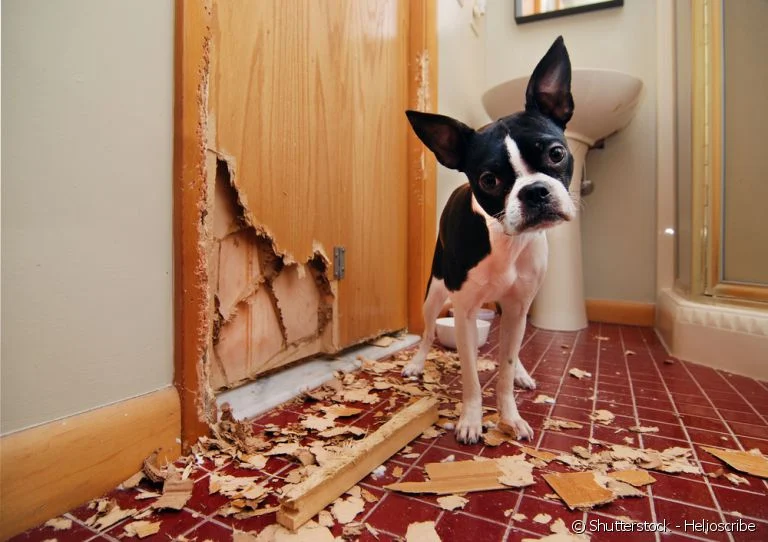
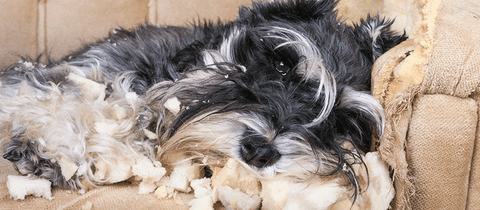
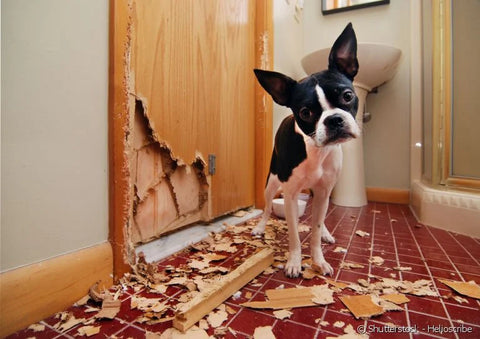
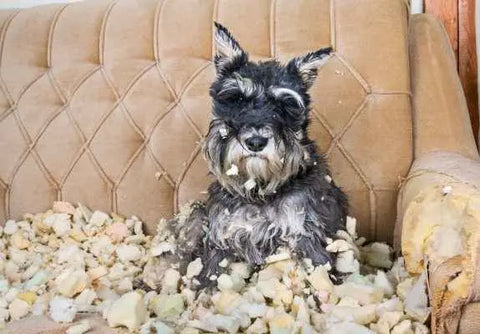
Like people, dogs can get scared, nervous and anxious. I have a friend whose dog suffers from severe anxiety problems. Anxiety attacks occur when it rains, thunders or the wind howls a little too loud. Your dog doesn’t like loud noises and even gets anxious when the vacuum cleaner or dishwasher is working. As a way to relieve stress, the dog either walks around or tries to hide behind the furniture. With anxiety, he also rips and bites the pet owners’s clothes and bed linen. Despite all that, my friend refuses to give the dog anxiety medication.
We can agree, or not, with this decision, but I think it costs nothing to start by trying the natural path!
When it comes to canine anxiety, there are several things you can do to help comfort and calm your hairy baby. Then I share 7 ways to do it!
But first, let’s take a closer look at anxiety in dogs.
A little bit about canine anxiety
The first step to relieve your dog’s anxiety is to identify the exact cause. Anxiety in dogs can be triggered by a number of things.
Situational / related to fear – means your dog is afraid of something specific, such as veterinarian, shearer, car rides, storms or loud noises. If you have adopted a new dog from an institution or shelter, your fears are probably deeply rooted in a healing past experience.
Behavioral anxiety, such as separation anxiety.
After identifying the exact trigger, work with your dog to help you overcome those fears. Dog behavior expert Kathy Reilly said:
“Work to change your mind about specific triggers, associating something good with something scary. In other words, if your dog is afraid of the mailman, try to give him cookies as soon as the mailman shows up and doesn’t stop until the mailman leaves. With every practice, you’ll see your dog react less and less. This is because you changed the association with the mailman. He’s no longer a threat, becoming a cookie association. In time, you’ll need less and less candy because your dog will stop being afraid of the mailman.”
Likewise, if your dog is afraid of an object such as the vacuum cleaner, for example, turn it off and leave it nearby while feeding your dog a tasty meal or give him some cookies. Reward good behavior!
While you work with your dog to change root behavior, the ideas below can help bring a little relief to your anxious puppy.

Signs of canine anxiety:
- Thief or howl / cry
- Restlessness, breathing rhythm, or excessive
- Tremors
- Chewing or destructive behavior
- Having accidents / Urine inside the house
- Assault
- Excessive lambs
- Loss of appetite, refusal to eat
7 Ways to Calm An Anxious Dog Naturally
1. Exercises and brain games
Before your puppy goes through a stressful situation (e.g. a trip to the veterinarian, shearer or a car ride), it’s great to do some exercise and brain games. Go out for a walk around your neighborhood, play frisbee, play ball for a search game or play with a triune toy, help tire your dog and act like a great tranquilizer for two main reasons:
- Stimulates serotonin production, a chemical of the brain to feel good
- Get rid of the repressed energy that can worsen an anxiety attack
2. CBD Oil
CBD for dogs can bring some improvements: for example for joint pains, such as seasonal allergy calmer and also to improve mood.
How does it work exactly? Well, it’s all about the endocannabinoid system (ECS) that was first discovered in early 1990 when scientists were exploring the cannabis plant.
So what exactly is ECS? Well, let’s split the word:
- “Endo” means “inside”. That tells us it’s produced naturally inside the body.
- “Cannabinoid” refers to cannabis.
Therefore, “endocannabinoid” simply means cannabis-like substances that occur naturally in the body.
The ECS consists of three parts:
- Endocannabinoids
- Receptors – There are two types (CB1 and CB2) that are found in the brain, organs, nerves and immune system. These receptors regulate many important functions.
- Endocannabinoids and cannabinoids.
According to Dogs Naturally magazine:
“Your dog’s body releases endocannabinoid chemicals on its own. These connect with receptors that stimulate the natural ability to create serotonin. Serotonin is a natural mood stabilizer. Research shows that CBD increases this capacity. He interacts with the nervous system to relieve and soothe anxiety.”

3. Dog Pheromone (DAP)
PAD is a synthetic chemical based on a hormone produced by lactating bitches. It’s that hormone that helps keep the puppies calm. Although scientific studies show that PAD works with puppies, researchers say it is unclear whether PAD works with anxious adult dogs. However, the DAP helped calm my friend’s dog and it’s definitely worth a try!
The DAP comes as a plug-in diffuser with bottles lasting 30, 60 or 90 days. Don’t worry about the smell: humans can’t smell it. Also, there is also a spray bottle, perfect for travel!
4. Essential Oil of Lavender
Lavender is known as the best calming agent and can help your dog overcome stress. Many pet owners swear that simply rubbing some essential oil into their dogs’ hair helps calm them down during a storm or a car ride. But don’t take my word for it. The effects were tested in 2006 during a clinical study examining 32 dogs with a history of travel-induced excitement. The results? Dogs spent significantly more time resting and sitting and less time moving and vocalizing when exposed to the smell of lavender versus no smell. Before using essential oils on your dog, make sure to dilute them with a transporter oil – such as coconut, almond or olive oil.
5. Quiet music
Music can be extremely effective to calm your anxious dog. Although you can simply turn on Pandora or Spotify and play a smooth song, there are playlists specifically designed to soothe dog anxiety.
For example, the company Through a Dog’s Ear offers a selection of soothing songs for pets. It comes preloaded with 4 hours of clinically tested music.
6. Close protection vest Thunder
A protective vest is very similar to the blankets we use to involve a baby to convey a sense of safety. The well wrapped clothes apply pressure to your dog’s body, promoting a feeling of comfort and safety. It is believed that this continuous pressure calms the nerves of an anxious dog!
7. Dog massage
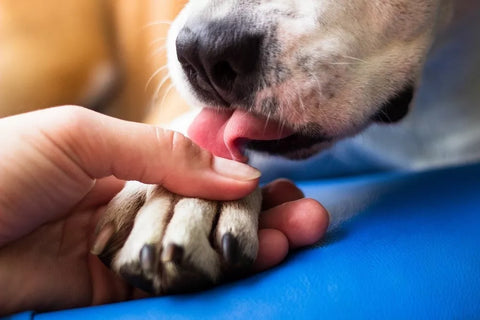
It is no secret that most dogs love to be caressed, rubbed and massaged. Boy, when I stop petting my puppies, they immediately reach out and start scratching my hand. It’s their way of saying, “Don’t stop! Continue! Besides feeling good, did you know that a regular massage offers many health benefits to your dog? In addition to improving blood circulation, help in digestion and relieve muscle tension, a canine massage can actually promote relaxation and relieve anxiety!
*Note: If your dog suffers from severe anxiety, you should consult your veterinarian.